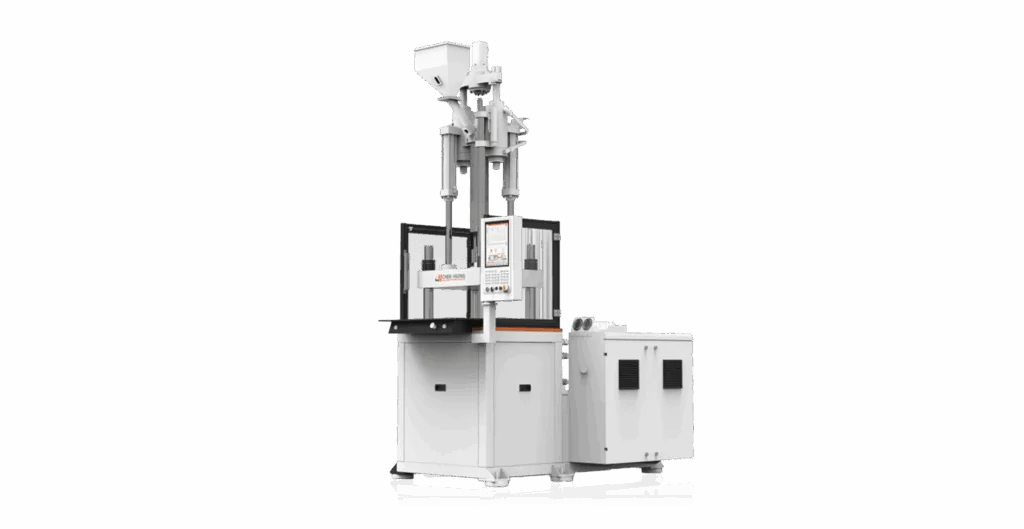
Choose a vertical machine for insert molding that horizontal machines can’t reliably do, a compact footprint that fits where horizontal machines won’t, and multi-station configurations that double output for insert-heavy production.
A vertical injection molding machine has its clamping unit oriented vertically rather than horizontally.
The mold opens upward, leaving the lower platen accessible for loading inserts. This is the irreplaceable advantage of vertical: gravity holds metal inserts, electronic components, cable ends, and threaded inserts securely in the lower mold half while the upper mold closes from above, something a horizontal machine cannot do reliably.
The vertical layout also occupies significantly less floor space than horizontal machines of equivalent tonnage.
Every Chen Hsong machine is ready for smart manufacturing through the iChen™ platform. iChen™ Smart Factory connects machines, automation, and production systems into a complete MES solution. iChen™ Cloud provides real-time monitoring, quality tracking, and data-driven operations across your entire fleet. iChen™ AI Molder applies AI-driven process intelligence to optimize molding parameters, reduce defects, and stabilize output, without relying on operator experience alone.

As a global injection molding machine supplier with 120+ service locations, Chen Hsong supports manufacturers in automotive, packaging, electronics, medical, home appliance, and industrial production with machines, automation, and smart factory solutions.
Chen Hsong offers one of the industry’s broadest vertical lineups, with seven configurations across four architectures covering applications from simple insert molding through high-throughput continuous production.
The V Series (vertical clamping with vertical injection) handles fixed-platen, single-slide, double-slide, and rotary loading. The W Series adds tieless two-platen clamping and a low work height with round rotary tables up to φ2400mm. The H Series pairs vertical clamping with a horizontal injection unit for larger shot capacity.
The C Series opens the mold on all sides with tieless clamping for compact, automation-friendly work. Any vertical configuration can also be supplied for liquid silicone rubber (LSR) molding with the LSR-1000s metering unit, including two-colour silicone-plus-plastic parts on the rotary configurations. The range covers 35 to 600 tonnes.
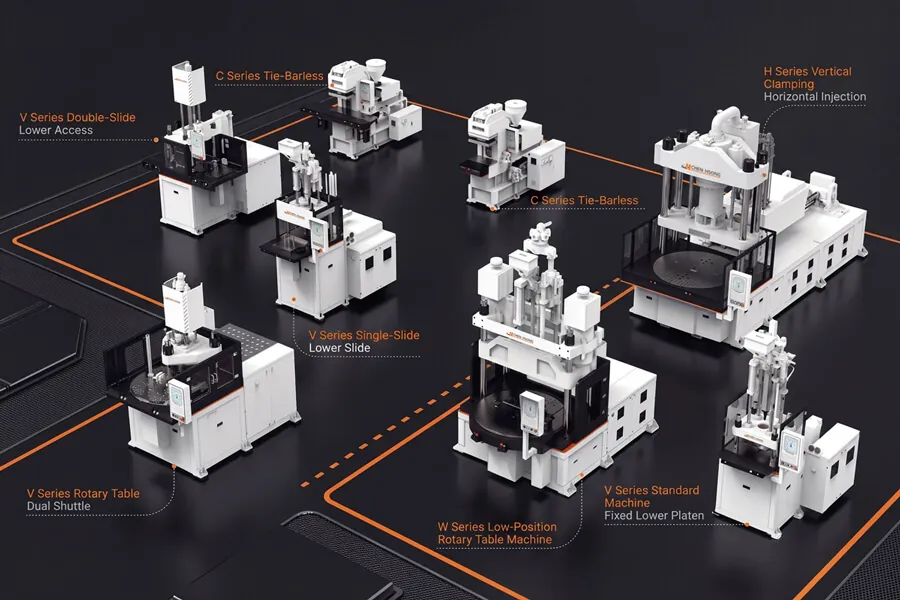
Chen Hsong’s vertical range groups into four architectures and up to four operating modes. The architecture (V, W, H, or C) sets the clamping design and machine layout; the mode (Standard, Single-Slide, Double-Slide, Rotary) sets how inserts are loaded and how stations alternate. Identify your architecture from tonnage, mold accessibility, and injection needs, then pick the mode from insert loading time and production volume.
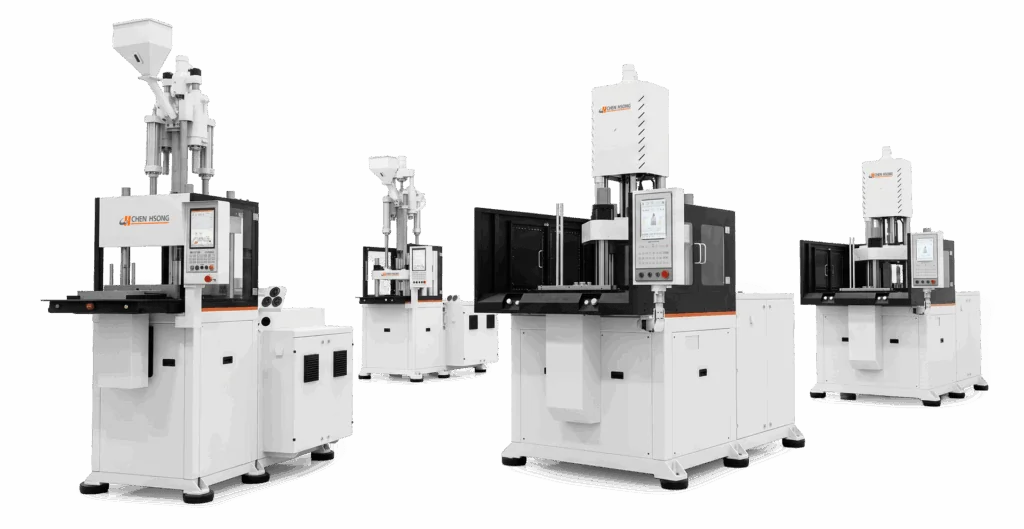
vertical clamping with vertical injection, the standard architecture for most small-to-medium insert molding. Available in standard, single-slide, double-slide, and rotary modes.
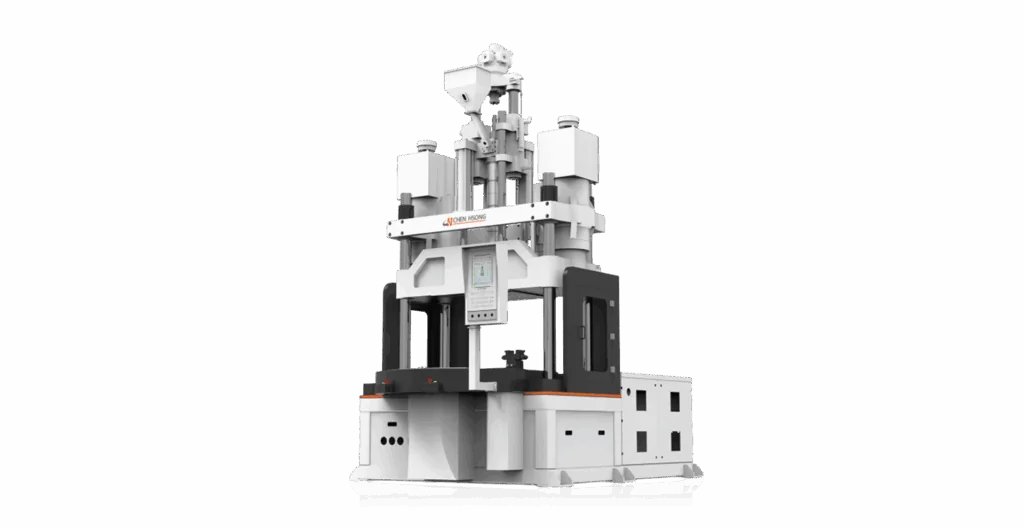
tieless two-platen rotary on a low work height frame for ergonomic manual loading; round rotary platens up to φ2400mm for larger molds and heavier inserts.
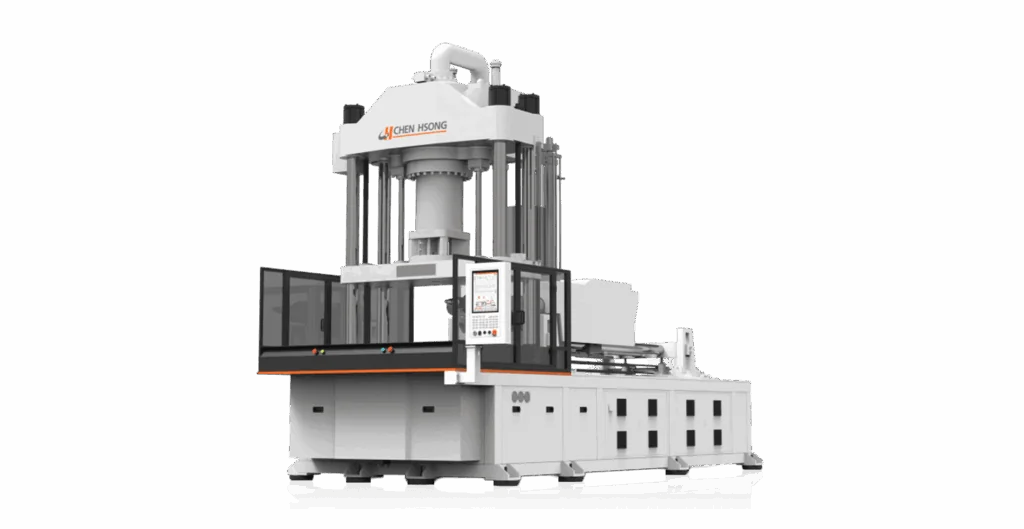
vertical clamping with a horizontal injection unit for larger shot weights, better plasticising, or easier screw maintenance; injection unit mounts left or right.
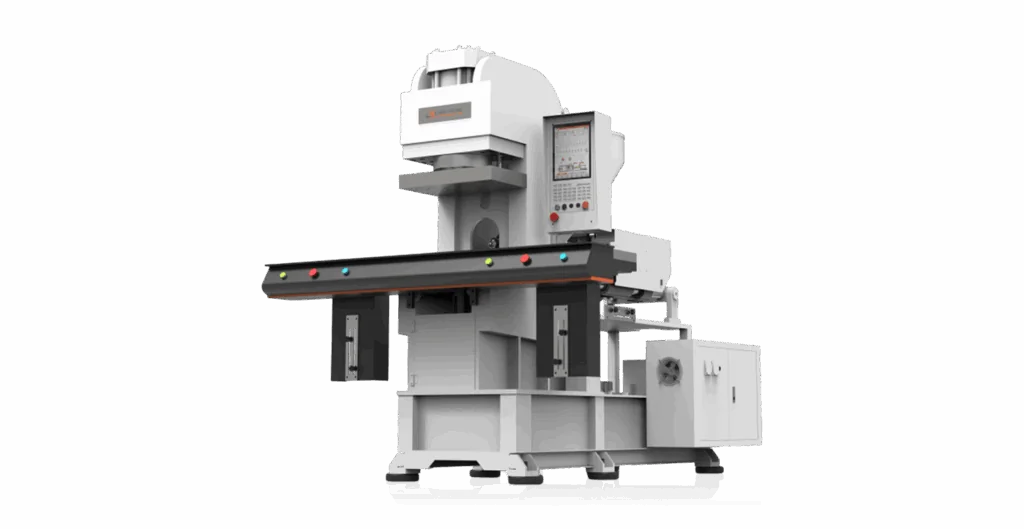
tieless vertical clamping with horizontal injection, the most automation-friendly architecture, with zero tie bars on a compact footprint.

Simplest and most economical, for low volume or fast insert loading.

The lower platen slides out for clear, ergonomic access.

Two platens alternate so loading and molding run at once, roughly doubling output.

The fastest changeover, and the only mode for two-colour and multi-colour work because rotational alignment ensures material registration.
Two-colour and multi-colour molding run on the Rotary mode, which provides the rotational alignment needed for material registration. Liquid silicone rubber (LSR) is available across the Double-Slide and Rotary configurations with the LSR-1000s metering unit.
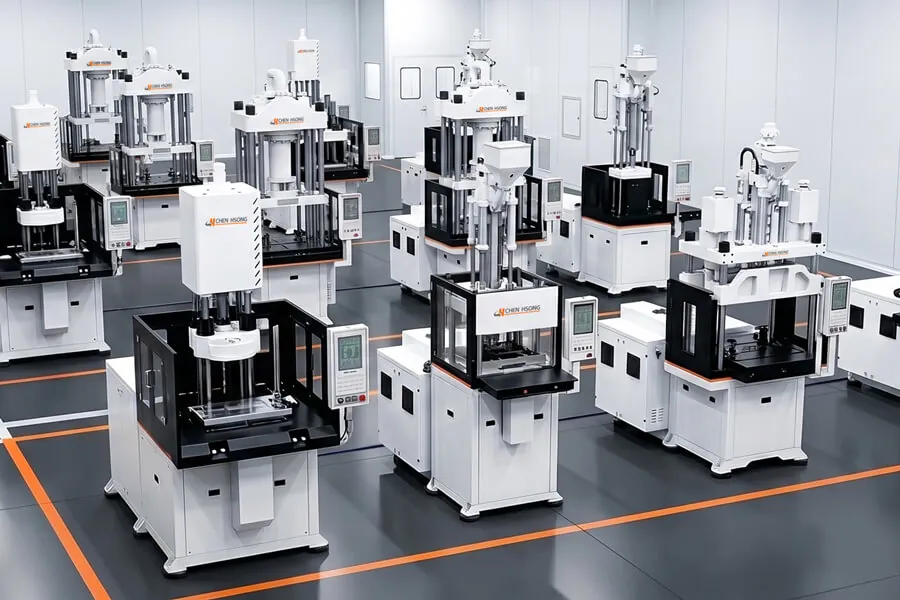
| Your Priority | Best Architecture | Best Mode |
|---|---|---|
| Simple insert molding, low volume | V Series | Standard |
| Easier insert access for operators | V Series | Single-Slide |
| Double output for insert-heavy work | V Series | Double-Slide |
| Highest throughput or two-colour | V Series | Rotary |
| Manual loading at higher tonnage | W Series | Rotary |
| Larger shot capacity with insert capability | H Series | Standard or Double-Slide |
| Automated production cell | C Series | Standard or Rotary |
| Liquid silicone rubber (LSR) parts | V / W / H Series | Double-Slide or Rotary |



Choose vertical when your part includes pre-placed components (metal inserts, threaded inserts, electrical contacts, cable ends, terminals) that must be encapsulated in plastic, because gravity holds the insert in the lower mold half while the upper mold closes, which a horizontal machine cannot do reliably.
Vertical also occupies far less floor space. Choose horizontal for general-purpose molding without inserts, where parts eject and gravity-feed out. For insert and overmolding work, vertical is the standard choice.
Selection depends on your insert loading method (manual or robotic), production volume, part size, clamping force, and whether you need single-station or multi-station continuous production.
As a guide: V Series for most small-to-medium insert work, W Series for ergonomic manual loading at higher tonnage, H Series when you need larger shot capacity with insert capability, and C Series for compact, automation-friendly cells.
Tie-bar designs use four vertical tie bars to distribute clamping force, the standard layout that gives the highest clamping force at a given machine size.
Tie-bar-less designs (the W and C Series) remove the tie bars, leaving the mold area open on all sides for unrestricted manual loading, robotic automation, and larger molds. The trade-off is typically lower maximum clamping force at the same machine size.
Choose tie-bar for higher tonnage; choose tie-bar-less when accessibility, automation, or oversized molds are the priority.
The largest users are electronics and electrical (cable assemblies, connectors, switches, sensors, plug overmolding), automotive (sensors, harness connectors, threaded inserts, bushings), medical devices (cannulae, syringe and catheter components), consumer products (toothbrushes, hand tools, fasteners), and industrial components (bearings and gears with metal cores).
Any product combining a pre-placed component with molded plastic is a candidate.
Yes. Chen Hsong vertical machines support standard robot interfaces and signal protocols, so robots, conveyors, automated insert feeders, and pick-and-place systems from most major suppliers can be integrated.
Vertical machines suit automation well because the upward-opening mold leaves the work area accessible from above, and the tieless C and W Series give robots the clearest paths of all.
Yes. Chen Hsong vertical models can be configured for liquid silicone rubber (LSR) molding, supplied with the LSR-1000s metering and dosing unit.
Vertical clamping suits LSR insert molding and overmolding because gravity holds the insert during molding, and the rotary and two-colour configurations support multi-material silicone-plus-plastic parts. LSR versions use a pneumatic shut-off nozzle for clean, flash-free silicone components.
Have a question that is not covered in the FAQ? Our AI assistant can help you find answers, products, or the right next step.


Choose Your Region
The Chen Hsong Group has offices and distributors all around the globe.
Select your region from below or search our global list of distributors.
This page is currently in development. Our team is putting it together, please check back shortly or reach out if you need anything in the meantime.
| Service | Cookies | Description |
|---|---|---|
| Google Analytics | _ga _ga_* _gid _gat _gcl_au | Google Analytics is used to collect anonymous statistics about how visitors use our website, such as pages visited, time spent on site, and traffic sources. This helps us understand and improve the user experience. |
| Service | Cookies | Description | |
|---|---|---|---|
| Google Analytics | _ga _ga_* _gid _gat _gcl_au | Google Analytics is used to collect anonymous statistics about how visitors use our website, such as pages visited, time spent on site, and traffic sources. This helps us understand and improve the user experience. |