
What Is Medical LSR Injection Molding? A Practical Guide for Medical Manufacturers

Reading Time: 5 min

Medical LSR injection molding is a process for producing precision components from liquid silicone rubber, or LSR. Two liquid silicone components are accurately metered, mixed, injected into a precision mold, and cured inside the heated mold.

Unlike conventional thermoplastic injection molding, LSR is injected relatively cool and crosslinked through heat in the mold. This makes material metering, air management, mold precision, temperature control, and automated handling important when selecting a medical-grade LSR injection molding machine.
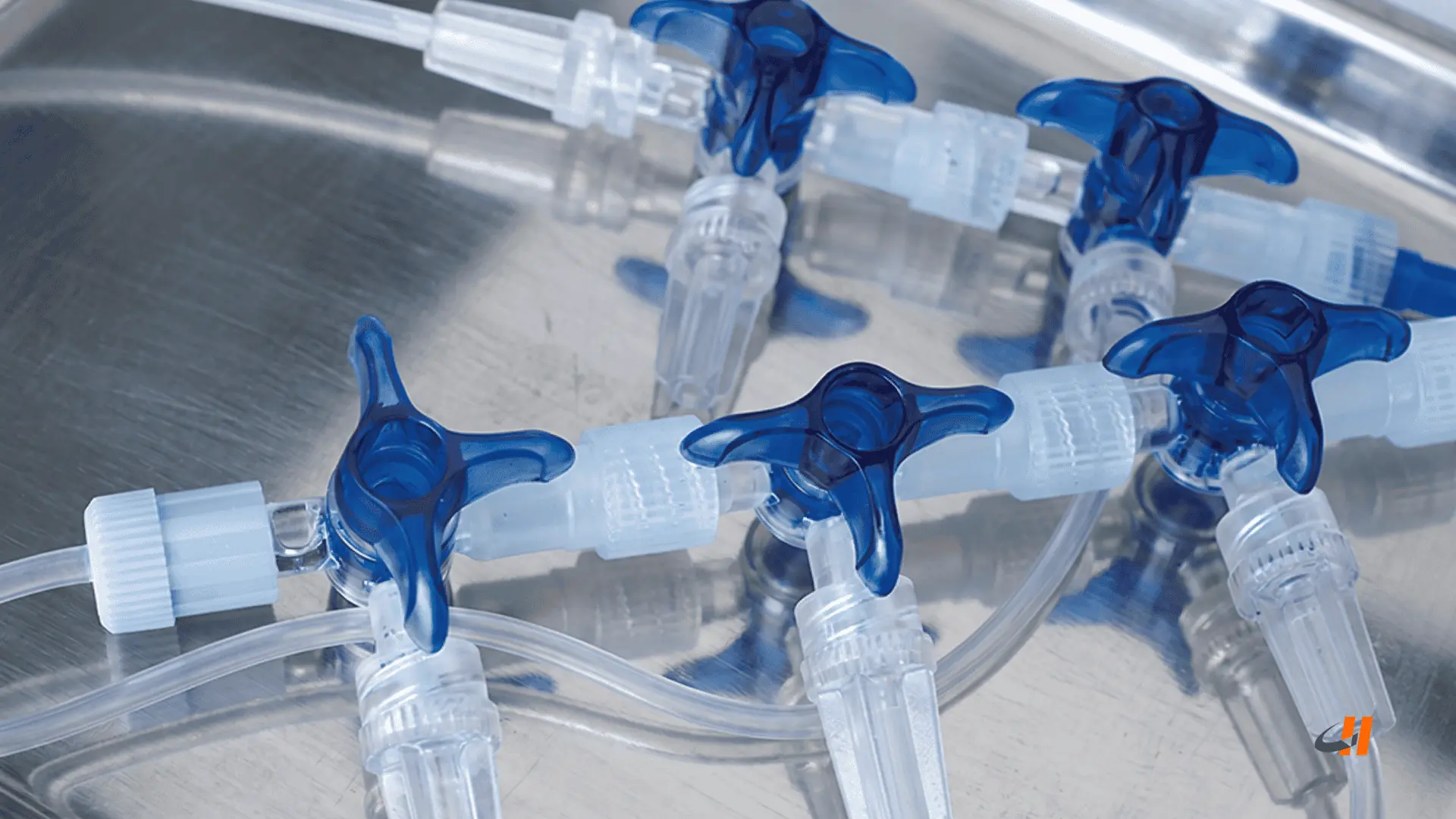
Medical LSR molding can support medical tubing, connectors, fittings, seals, valves, and transparent or optical components. The machine, mold, material delivery, and controls should be evaluated together.

A molding machine does not by itself make a finished medical device compliant, sterile, implantable, or clinically suitable. Those outcomes depend on the material, component design, manufacturing environment, quality system, validation process, and applicable requirements.
How does the medical LSR molding process work?

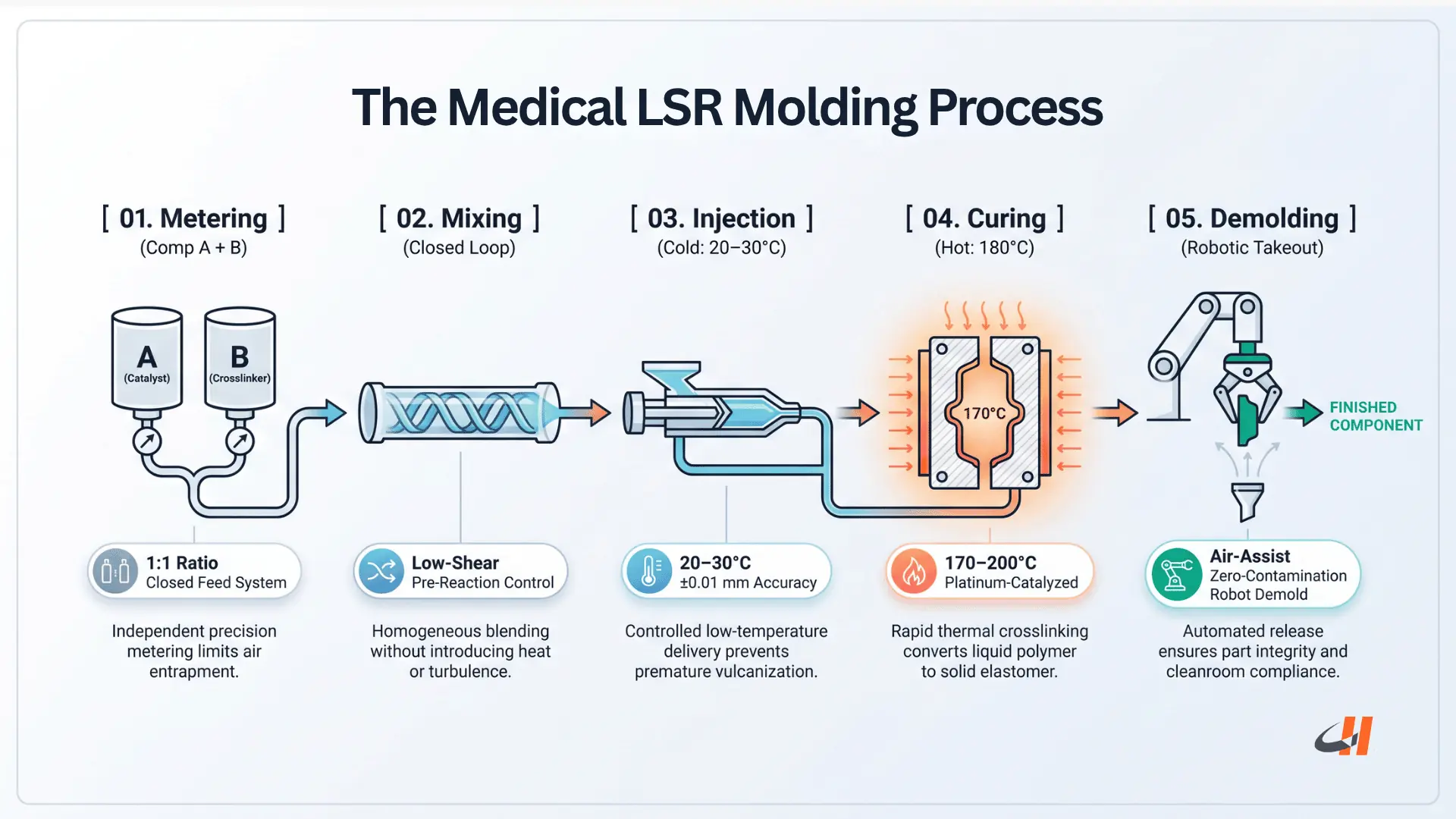
The process has five main stages: material preparation, static mixing, precision injection, curing, and demolding.

1. A/B material metering and static mixing

LSR uses two components, commonly called A and B. In a typical system, A contains the catalyst and B contains the crosslinking agent. The components are independently supplied and accurately metered, typically at a 1:1 ratio, before passing through a static mixer.

2. Static Mixing

After metering, the A and B components pass through a static mixer. The mixer combines the two components into a consistent material without relying on mechanically rotating mixing elements.
Low-shear mixing and closed material delivery can help limit premature reaction and air entry before injection. This supports a more consistent material flow into the precision injection system.

3. Precision injection

The mixed LSR is injected into the mold at a relatively low material temperature. The deck gives an example of approximately 20–30°C for injection and states a 0.01 mm injection-precision figure for the described solution.

4. Hot-mold curing

The mold acts as a controlled reaction environment. The presentation describes platinum-catalysed crosslinking and mold temperatures of approximately 170–200°C, with a representative comparison showing about 180°C for the LSR mold.

Heat transforms the liquid material into its finished elastomeric form. Temperature consistency is important in multi-cavity molds because uneven conditions may contribute to part variation.

5. Demolding and post-processing

After curing, the component is removed from the mold. The deck describes air-assisted release, mechanical cleaning or wiping, and robot-assisted removal to support repeatable demolding, cleanliness, and reduced handling.


Why is LSR molding called a reverse thermal process?

LSR molding is sometimes described as a reverse thermal process because the material and mold have opposite temperature roles compared with a typical thermoplastic cycle.


Process characteristic
LSR molding
Typical Thermoplastic
Injection material temperature
Approx. 20–30°C
Approx. 220–280°C
Mold temperature
Approx. 170–200°C
Approx. 40–80°C
Material transformation
Chemical crosslinking or curing
Heat transfer and cooling
Air removal
Active vacuum described
Passive venting described

This difference affects the injection unit, runner system, mold, heating system, and process controls.


What equipment does a medical LSR injection molding system need?

A complete medical LSR molding solution can include the following elements.
  • All-electric injection unit: The deck presents an all-electric unit with coordinated clamping, injection, and mold-temperature functions. It also describes plunger-based injection, intended to avoid shear heat associated with conventional screw designs.
  • Cold runner and valve gate: A cold runner keeps LSR liquid before it reaches the cavity. Cooled manifolds help prevent premature curing. Pneumatic or hydraulic needle valves close after injection to reduce stringing and gate residue.
  • Vacuum integration: Vacuum removes air before injection and is connected in the presentation with tight-tolerance molding and reduced burn-mark risk. Mold design, venting, delivery, and process conditions also influence air management.
  • Thermal control: The deck describes heat isolation between the hot mold and cooler platen, cavity heating, thermocouples, and PID closed-loop control. It states a multi-cavity temperature-consistency target of approximately ±1°C for the described system; this should be confirmed for the applicable configuration.
  • Automation and handling: Air-assisted demolding, mechanical cleaning, inspection integration, and robot-assisted removal can support repeatable production. ISO Class 7/8 cleanroom-oriented production is possible in an appropriately designed installation, but this does not automatically establish sterility.


What medical components can be made with LSR molding?

Common medical LSR application groups include:

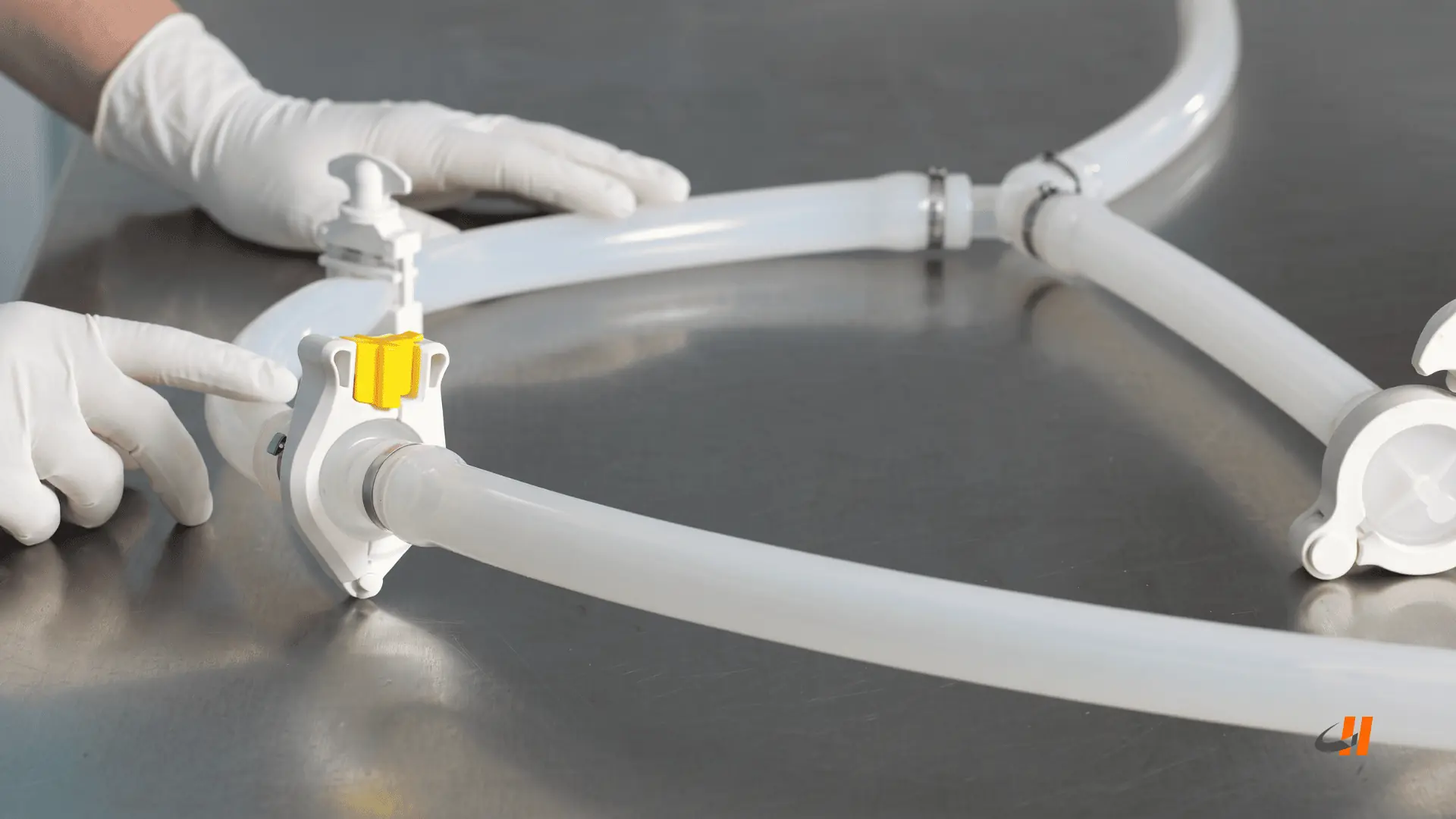
  1. Medical silicone tubing and fluid-path components, where dimensional control and clean production are important.
  2. Connectors and fittings, including Luer-style, barbed, quick-disconnect, flared or compression, and custom multi-port designs.
  3. Seals and valves, including O-rings, diaphragm valves, and check valves.
  4. Transparent or optical components, where surface finish and control of bubbles or flow marks matter.
Suitability depends on the material grade, geometry, tolerance, production volume, mold, process window, and validation requirements.

How should you select a medical-grade LSR injection molding machine?

Evaluate the complete system, not only the machine nameplate. Confirm A/B metering, injection repeatability, closed delivery, vacuum, thermal control, runner and gate integration, demolding, maintenance, data capture, and batch traceability.
The right machine matches the component and production requirements while providing a controlled, repeatable process.

Frequently asked questions

What is medical LSR injection molding?

It is the process of metering and mixing two liquid silicone components, injecting the mixture into a precision mold, and curing it in a heated mold to produce medical components such as tubing, connectors, seals, valves, and selected transparent parts.

What is a medical-grade LSR injection molding machine?

It is an LSR injection molding machine configured for controlled medical-component production. Relevant capabilities may include precision A/B metering, static mixing, controlled injection, mold-temperature management, vacuum, cold runners, valve gates, automation, and production-data capture.

How does LSR molding differ from thermoplastic injection molding?

LSR is injected relatively cool and cured in a hot mold. Thermoplastics are generally heated for injection and cooled in the mold. LSR therefore requires different material-delivery, runner, heating, venting, and curing controls.

What medical parts can be made with LSR injection molding?

Applications include medical tubing, Luer-style connectors, fittings, seals, valves, and selected transparent or optical components. Suitability must be assessed for the specific material and part.

How can an LSR machine help reduce bubbles and flash?

Closed delivery, plunger-based injection, integrated vacuum, precision mold construction, controlled injection, cold runners, and valve gates can help manage these risks. Results depend on the material, mold, geometry, equipment configuration, and validated process window.

What should I ask before buying an LSR injection molding machine?

Ask about A/B metering, injection control, vacuum, mold and thermal capability, runner and gate design, automation, maintenance, traceability, validation documentation, and experience with the intended component.

Request a medical LSR application review

Are you evaluating a medical-grade LSR injection molding machine for tubing, connectors, seals, valves, or another precision component? Share your part drawing or key requirements. Our team can review the material, geometry, tolerances, cavity plan, volume, temperature, automation, maintenance, and traceability needs.
Final decisions should be based on application-specific testing and documentation.
Contact your local Chen Hsong branch for a review.

Choose Your Region

The Chen Hsong Group has offices and distributors all around the globe.
Select your region from below or search our global list of distributors.