
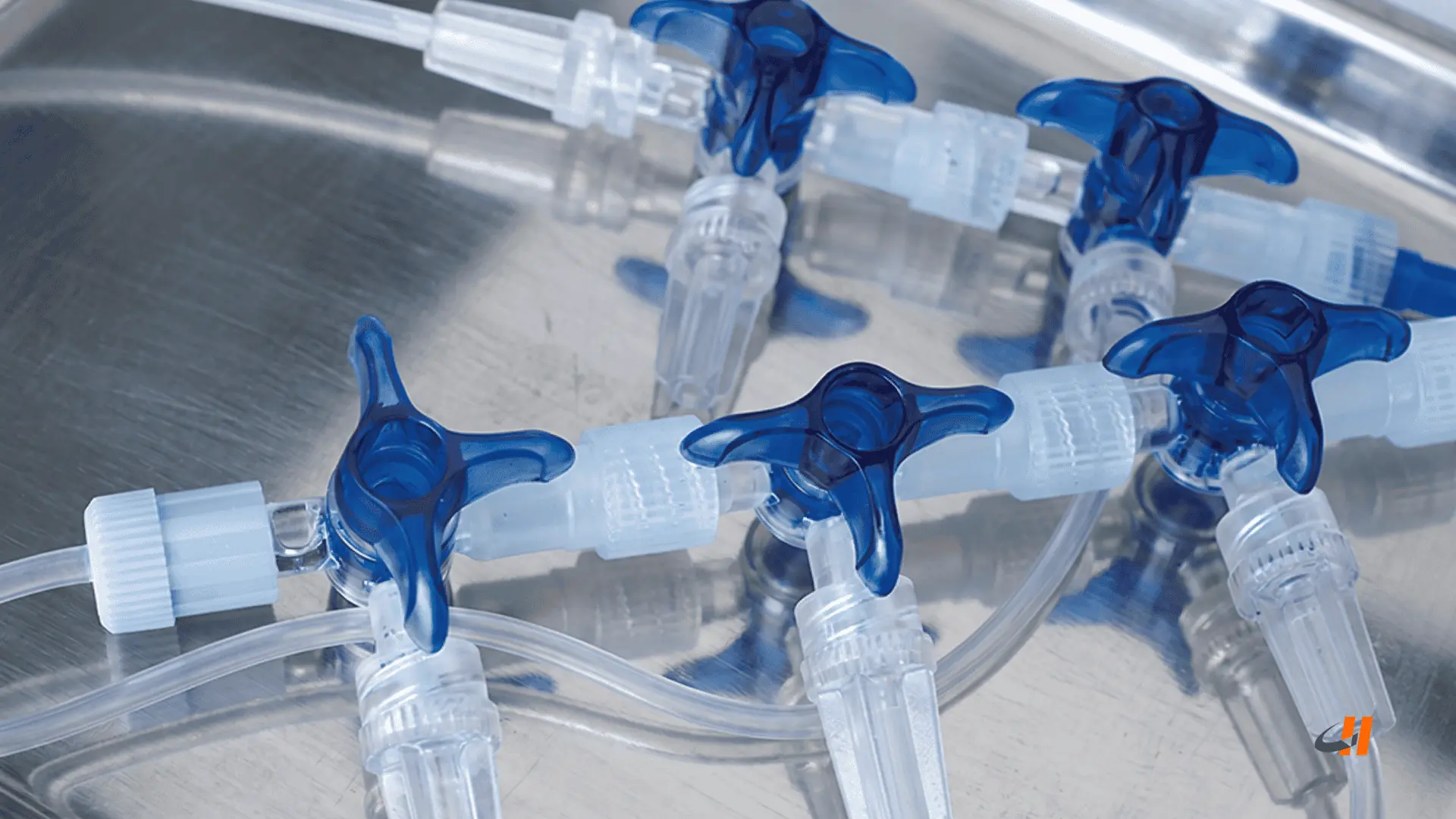
Medical LSR injection molding is a process for producing precision components from liquid silicone rubber, or LSR. Two liquid silicone components are accurately metered, mixed, injected into a precision mold, and cured inside the heated mold.
A molding machine does not by itself make a finished medical device compliant, sterile, implantable, or clinically suitable. Those outcomes depend on the material, component design, manufacturing environment, quality system, validation process, and applicable requirements.
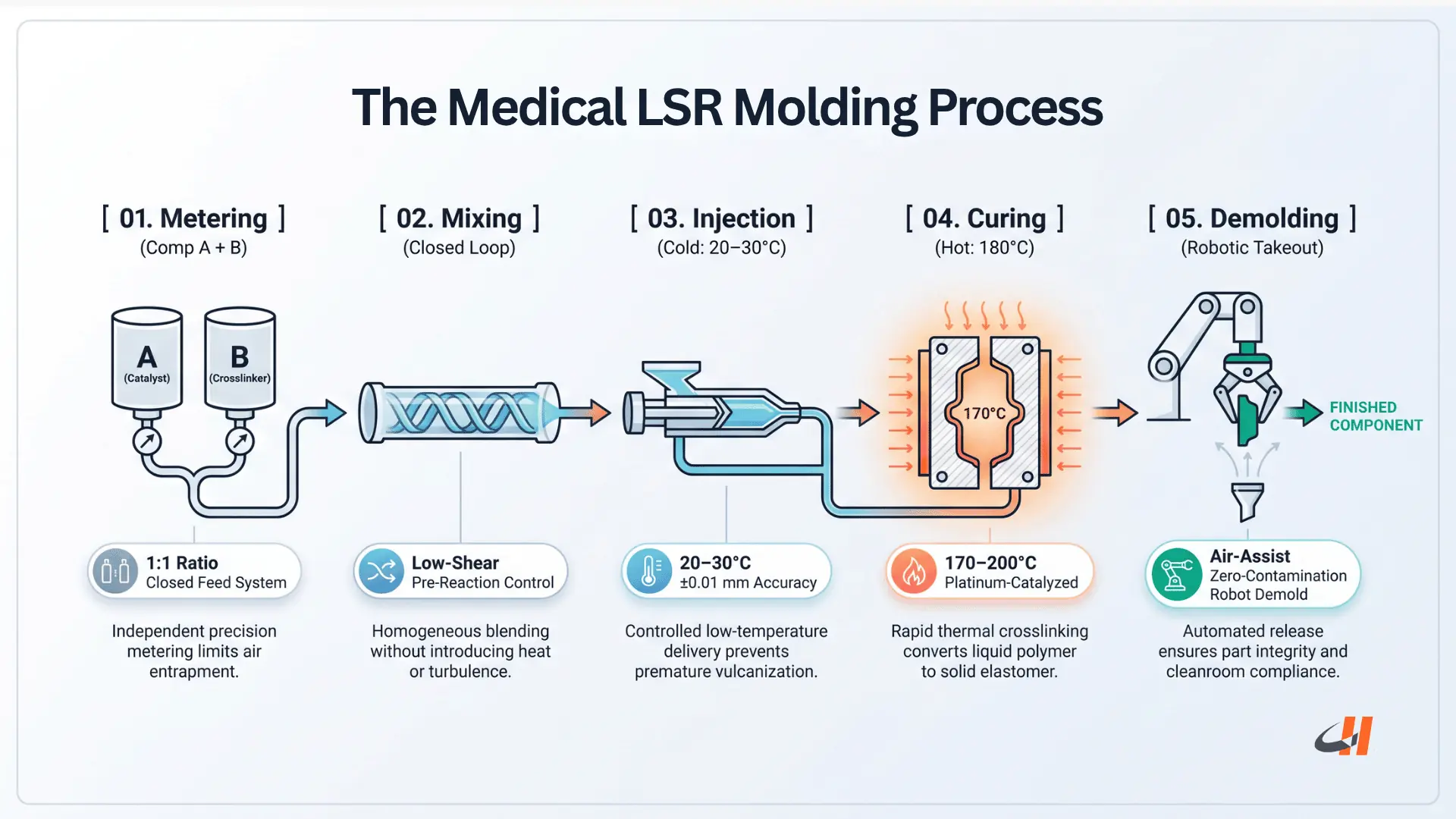
How does the medical LSR molding process work?
1. A/B material metering and static mixing
LSR uses two components, commonly called A and B. In a typical system, A contains the catalyst and B contains the crosslinking agent. The components are independently supplied and accurately metered, typically at a 1:1 ratio, before passing through a static mixer.
2. Static Mixing
3. Precision injection
4. Hot-mold curing
The mold acts as a controlled reaction environment. The presentation describes platinum-catalysed crosslinking and mold temperatures of approximately 170–200°C, with a representative comparison showing about 180°C for the LSR mold.
Heat transforms the liquid material into its finished elastomeric form. Temperature consistency is important in multi-cavity molds because uneven conditions may contribute to part variation.
5. Demolding and post-processing
Why is LSR molding called a reverse thermal process?
LSR molding is sometimes described as a reverse thermal process because the material and mold have opposite temperature roles compared with a typical thermoplastic cycle.
Process characteristic | LSR molding | Typical Thermoplastic |
Injection material temperature | Approx. 20–30°C | Approx. 220–280°C |
Mold temperature | Approx. 170–200°C | Approx. 40–80°C |
Material transformation | Chemical crosslinking or curing | Heat transfer and cooling |
Air removal | Active vacuum described | Passive venting described |
This difference affects the injection unit, runner system, mold, heating system, and process controls.
What equipment does a medical LSR injection molding system need?
- All-electric injection unit: The deck presents an all-electric unit with coordinated clamping, injection, and mold-temperature functions. It also describes plunger-based injection, intended to avoid shear heat associated with conventional screw designs.
- Cold runner and valve gate: A cold runner keeps LSR liquid before it reaches the cavity. Cooled manifolds help prevent premature curing. Pneumatic or hydraulic needle valves close after injection to reduce stringing and gate residue.
- Vacuum integration: Vacuum removes air before injection and is connected in the presentation with tight-tolerance molding and reduced burn-mark risk. Mold design, venting, delivery, and process conditions also influence air management.
- Thermal control: The deck describes heat isolation between the hot mold and cooler platen, cavity heating, thermocouples, and PID closed-loop control. It states a multi-cavity temperature-consistency target of approximately ±1°C for the described system; this should be confirmed for the applicable configuration.
- Automation and handling: Air-assisted demolding, mechanical cleaning, inspection integration, and robot-assisted removal can support repeatable production. ISO Class 7/8 cleanroom-oriented production is possible in an appropriately designed installation, but this does not automatically establish sterility.
What medical components can be made with LSR molding?
Common medical LSR application groups include:
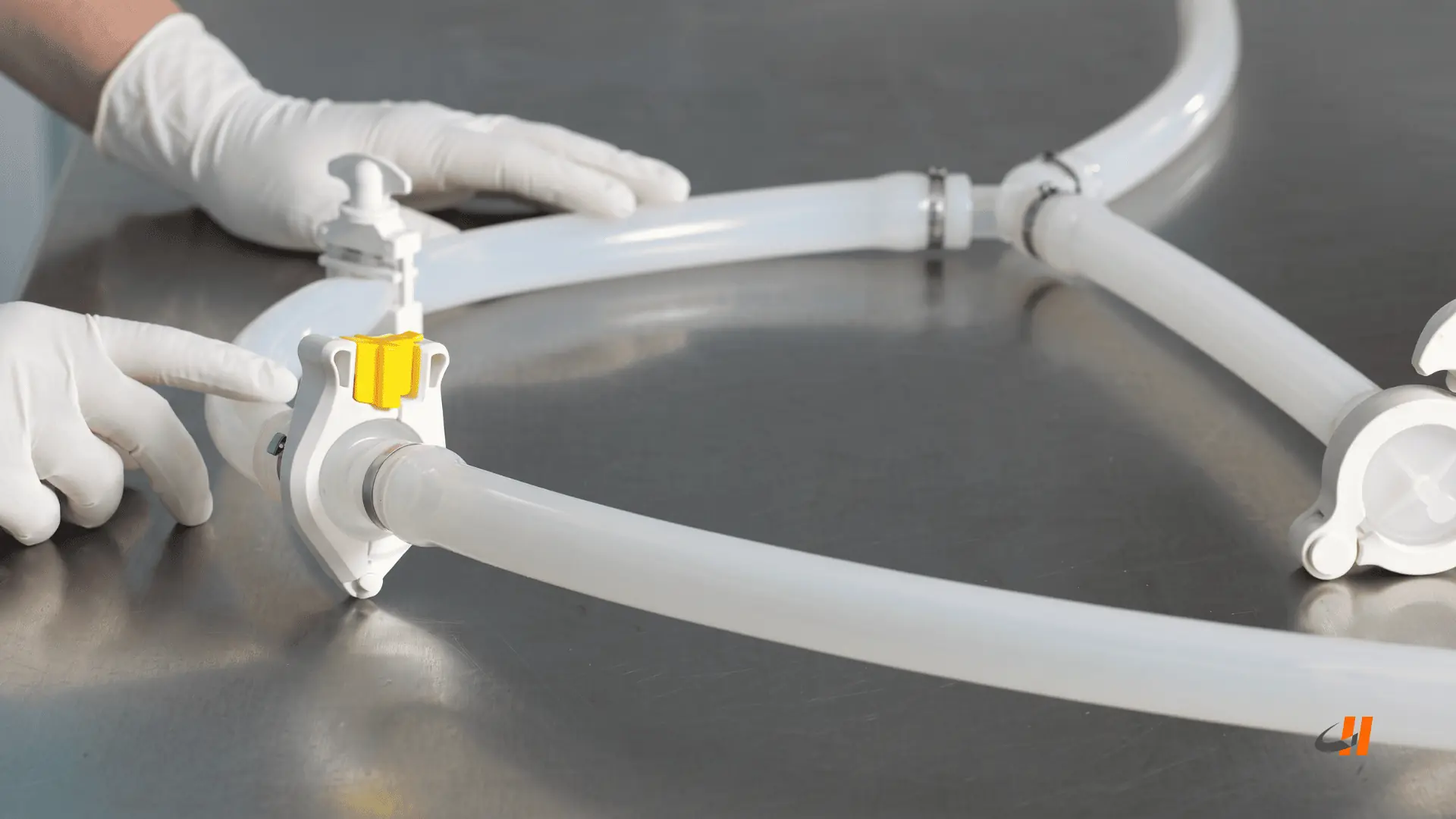
- Medical silicone tubing and fluid-path components, where dimensional control and clean production are important.
- Connectors and fittings, including Luer-style, barbed, quick-disconnect, flared or compression, and custom multi-port designs.
- Seals and valves, including O-rings, diaphragm valves, and check valves.
- Transparent or optical components, where surface finish and control of bubbles or flow marks matter.

