

Important note: This article is a manufacturing-readiness guide, not legal advice or a declaration of PPWR conformity. PPWR obligations depend on the packaging format, material, market role, product category, applicable implementing acts, and the specific facts of each supply chain. Manufacturers should confirm their obligations with qualified legal, regulatory, and technical advisers.
PPWR has moved packaging compliance from a product claim to an evidence problem
For many injection-molded packaging manufacturers, the first PPWR question is simple: “Does this regulation affect us?” PPWR is not limited to EU-based manufacturers: if your business sells packaging or packaged products into the EU, it applies to the packaging placed on that market. The more useful question is more operational: “What evidence will our customers, suppliers, and market-surveillance authorities expect us to connect to every packaging format we place on the EU market?”
The EU Packaging and Packaging Waste Regulation, Regulation (EU) 2025/40, has been in force since 11 February 2025 and has applied from 12 August 2026. It establishes a directly applicable EU-wide framework for packaging placed on the EU market, regardless of material or origin. The framework addresses the full packaging lifecycle, including eco-design, recycled content, waste prevention, reuse, collection, and recycling.
For injection molders, PPWR is therefore not only a sustainability discussion. It is a design, material, production, quality, and documentation discipline. A cup, lid, tub, closure, tray, crate, pallet, or other molded packaging component may need a defensible story about what it is made from, how it was designed, what evidence supports its claimed performance, how it was produced, and how its information is controlled.
The practical shift: “Recyclable” can no longer be treated as a standalone marketing adjective. Manufacturers need a controlled evidence chain that links the packaging specification to the material, the molding process, the quality result, and the applicable compliance assessment.
This is where a digital evidence file becomes useful. It is not a new statutory document defined by PPWR. It is an operational way to organise the information a manufacturer may need to assess, demonstrate, update, and retrieve packaging-conformity evidence.
What is PPWR, and why does it matter to packaging manufacturers?
PPWR replaces the former Packaging and Packaging Waste Directive as the main EU framework for packaging and packaging waste. The European Commission states that the regulation covers all packaging and packaging waste, irrespective of material or origin, and that it creates mandatory rules for eco-design, recycled material content, reuse formats, waste prevention, collection, and high-quality recycling.
The regulation’s direction is clear. The Commission says the framework aims to make all packaging on the EU market recyclable in an economically viable way by 2030, safely increase recycled plastics, reduce virgin-material use, and harmonise rules across Member States.
The exact requirements and timeline will vary by packaging format and provision. However, manufacturers that mold plastic packaging should already assume that their customer conversations will increasingly involve recyclability design, minimised weight and volume, recycled-content evidence, substances of concern, reusable-packaging performance, labelling, and conformity documentation.
The Commission’s guidance also makes the role question important. In many cases, the company that manufactures packaging, or has packaging or a packaged product designed or manufactured under its own name or trademark, can be treated as the manufacturer for PPWR purposes. The manufacturer has responsibility for placing conforming packaging on the market and for drawing up the EU declaration of conformity, even when other parties provide underlying information or conduct work on its behalf. The precise legal role depends on the facts, including branding, contractual arrangements, and the type of packaging.
The PPWR checklist: Which packaging items could affect an injection molder?
A mold shop or converter does not need to solve every PPWR requirement at once. Use this checklist* to identify the information each packaging family may need.
| Packaging question to assess | Why it may matter under PPWR | Example of a molded-packaging record to control |
| What is the part and its market? | Sets scope and responsibility. | SKU, drawing revision, category, end use, and market. |
| What materials are used? | Affects claims, safety, and recycling. | BOM, resin grade, supplier, additives, and lot. |
| Is weight and volume minimised? | Packaging weight and volume must be justified. | Part weight, geometry, and functional-test data. |
| Is it designed for recycling? | Applicable recyclability criteria must be assessed. | Construction, components, and design-for-recycling assessment. |
| Does it contain recycled plastic? | Recycled-content claims need traceable input. | PCR declaration, calculation method, incoming check, and lot link. |
| Is it food contact? | Food-contact evidence and PFAS limits may apply. | Declaration, relevant test data, material specification, and lot link. |
| Is it reusable? | Reuse needs evidence of rotation, hygiene, and end-of-life design. | Rotation tests, care instructions, and traceability approach. |
| How is it labelled? | Information and marking requirements may apply. | Artwork revision, label approval, and release record. |
| How was it made and released? | Controlled production supports the evidence. | Mold, machine, approved settings, inspection, and release status. |
*This list does not determine legal compliance by itself. It helps a manufacturer spot the information that can otherwise become fragmented across procurement files, spreadsheets, mold books, quality records, production systems, and customer emails.
The five layers of a PPWR-ready digital evidence file
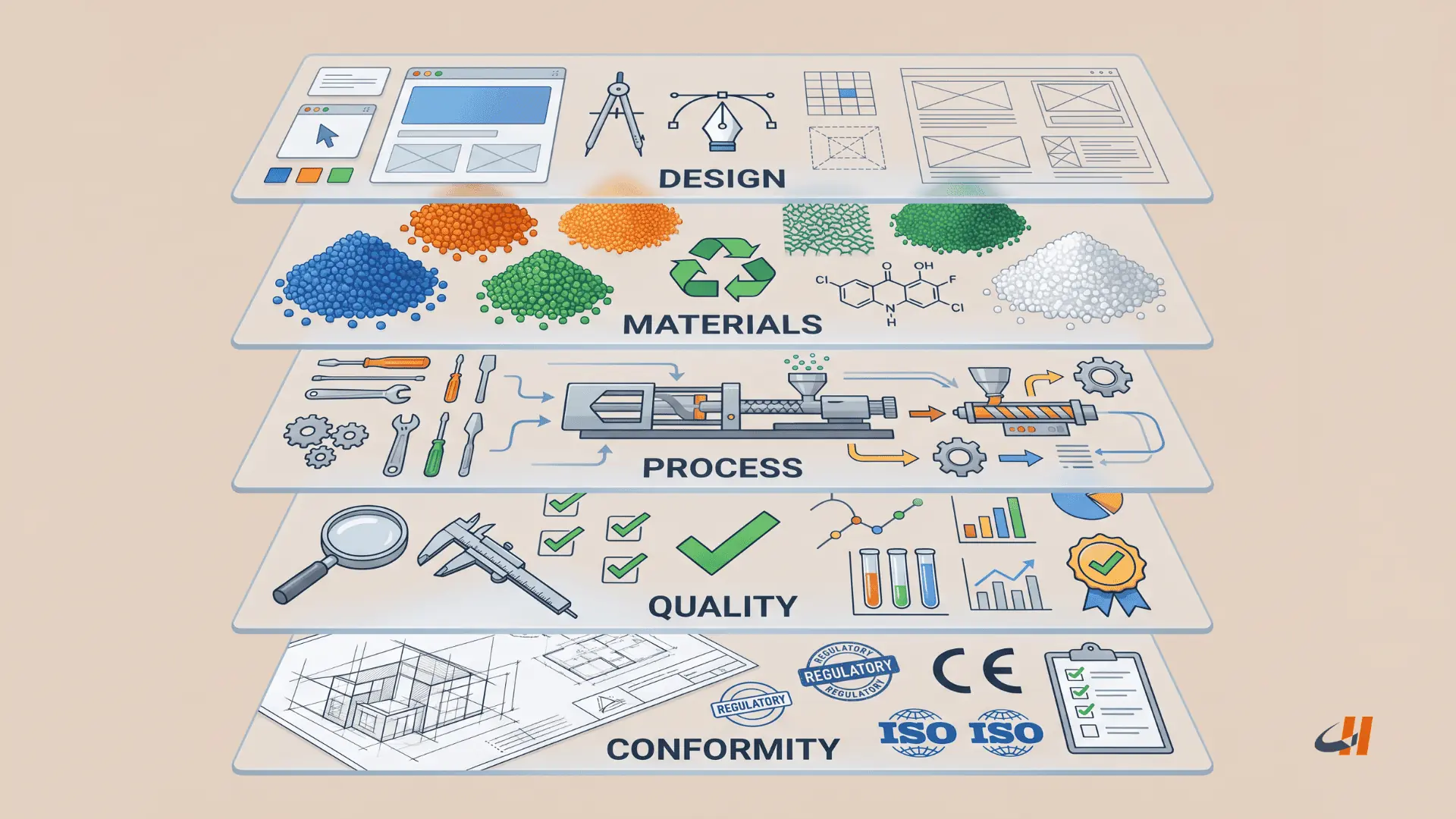
A digital evidence file has one purpose: make each packaging claim traceable to controlled records. Keep the structure simple and include only the records relevant to the pack.
| Layer | What it should show |
| 1. Design | Part identity, drawing revision, function, target market, and the design rationale. |
| 2. Materials | BOM, resin grade, supplier declaration, lot, and relevant PCR or food-contact evidence. |
| 3. Process | Mold, machine, approved settings, production lot, and controlled changes. |
| 4. Quality | Inspection results, functional tests, nonconformities, and corrective actions. |
| 5. Conformity | Relevant assessments, label approval, EU declaration of conformity, and customer records. |
The Commission’s PPWR guidance explains that manufacturers must place only conforming packaging on the market and draw up the EU declaration of conformity using supplier information and supporting documentation. Regulatory specialists should determine the legal file; the digital evidence file makes the underlying records controlled and retrievable.
How iChen™ Cloud can support the manufacturing-data layer

A digital evidence file is not achieved by buying a dashboard. It requires a data model, ownership, document control, approval rules, and cross-functional governance. However, iChen™ Cloud can provide a practical foundation for the manufacturing, quality, traceability, and controlled-process layers of that file.
iChen™ Cloud is Chen Hsong’s smart manufacturing operations platform for injection molding. It connects injection molding machines and auxiliary equipment across locations through industrial IoT gateways. The platform collects real-time data on equipment status, production progress, quality, and energy consumption, and can support remote parameter writing for proactive process control. Customer data remains customer-owned, with cloud and on-premise deployment options.
For a PPWR-focused packaging manufacturer, the most relevant question is not “Can software certify our packaging?” It cannot. The more useful question is: “Can our production system make the evidence behind our packaging claims easier to control, retrieve, and improve?”
The following iChen™ Cloud capabilities can support that objective when properly configured as part of the manufacturer’s wider quality and compliance workflow.
| iChen™ Cloud capability | Digital-evidence-file use case | Operational benefit |
| IoT device connectivity | Link machine and auxiliary-equipment identities to equipment status, cycle data, alarms, and efficiency metrics. | Reduces the gap between a part’s documentation and the production asset that made it. |
| MES production management | Connect production orders with materials, molds, process parameters, BOM data, work instructions, and resource records, with second-level traceability from raw material to finished goods. | Provides a structured production genealogy for material-sensitive or customer-critical packaging. |
| Parameter version control | Store the approved molding and process parameters with controlled changes and workstation access. | Helps prevent undocumented process drift and makes approved settings easier to retrieve. |
| QMS quality management | Digitise inspection standards and SOPs; connect incoming, in-process, final, and customer-feedback records with NCR, 8D, and CAPA workflows. | Makes a quality exception visible, assignable, and traceable to closure. |
| Energy management | Monitor electricity, water, gas, and heat across the plant and down to equipment where configured. | Supports operational efficiency analysis; it does not by itself prove a PPWR claim. |
| EAM equipment and mold management | Track maintenance, inspections, work orders, repair history, and equipment/mold health. | Helps show that process stability is supported by controlled equipment and mold maintenance. |
| Data platform and enterprise integration | Exchange data with ERP and other enterprise systems through standard interfaces. | Helps connect factory information to procurement, product master, document-control, and customer-service records. |
A realistic iChen™ Cloud use case: A PCR-containing thin-wall food container
Consider a manufacturer producing a thin-wall food container using an approved PCR-containing resin for an EU customer. The customer asks for current documentation to support a packaging review.
A well-configured operating model could retrieve the container SKU and drawing revision, the approved resin grade and supplier declaration, the material lot used, the approved process window, the mold and cavity configuration, the production order, in-process and final inspection results, nonconformity records if any, part weight, and the customer-approved packaging specification.
iChen™ Cloud is not the legal decision-maker in this example. It is the manufacturing-data backbone that helps the technical, quality, regulatory, and commercial teams find the correct records without rebuilding the story from disconnected systems.
Frequently asked questions about PPWR for packaging manufacturers
Does PPWR apply to injection-molded plastic packaging?
PPWR applies to packaging placed on the EU market regardless of material or origin. Whether a particular injection-molded component is within scope, and which requirements apply, depends on the component’s function, packaging category, market role, end use, and applicable provisions.
Is a declaration that a pack is “recyclable” enough for PPWR?
No. PPWR establishes a structured approach to packaging recyclability, including design-for-recycling criteria and later recycled-at-scale criteria. Claims should be supported by the applicable technical and legal evidence, not only by marketing language.
What is a PPWR digital evidence file?
A digital evidence file is not a PPWR-defined legal document. It is a manufacturer’s controlled way to organise the product, material, process, quality, and conformity information that may support PPWR assessments, customer requests, and internal change control.
Can iChen™ Cloud make a manufacturer PPWR compliant?
No. iChen™ Cloud does not determine legal compliance or replace conformity assessment, regulatory interpretation, testing, customer approvals, or an EU declaration of conformity. It can support the manufacturing-data, quality, traceability, parameter-control, and document-linkage elements that make the underlying evidence more usable.
Build evidence before the customer asks for it
PPWR raises the standard for packaging information. The manufacturer that waits for an urgent customer questionnaire or market-surveillance request will often spend days reconciling certificates, process sheets, emails, mold books, and spreadsheets. The manufacturer that has built a digital evidence file can respond with a controlled, current story.
Start with one packaging family. Link the drawing, material, mold, approved process, inspection result, and supporting documentation. Use iChen™ Cloud to make the factory-data layer visible and connected. Then expand the model as regulations, customer requirements, and packaging designs evolve.
A stronger packaging claim begins with a stronger evidence chain.
Get Your Production Ready for PPWR
Make your packaging production more traceable, connected, and prepared for changing regulatory requirements. Consult the Chen Hsong team for tailored iChen™ Cloud recommendations that strengthen process control, quality visibility, and digital evidence readiness across your production line.

