
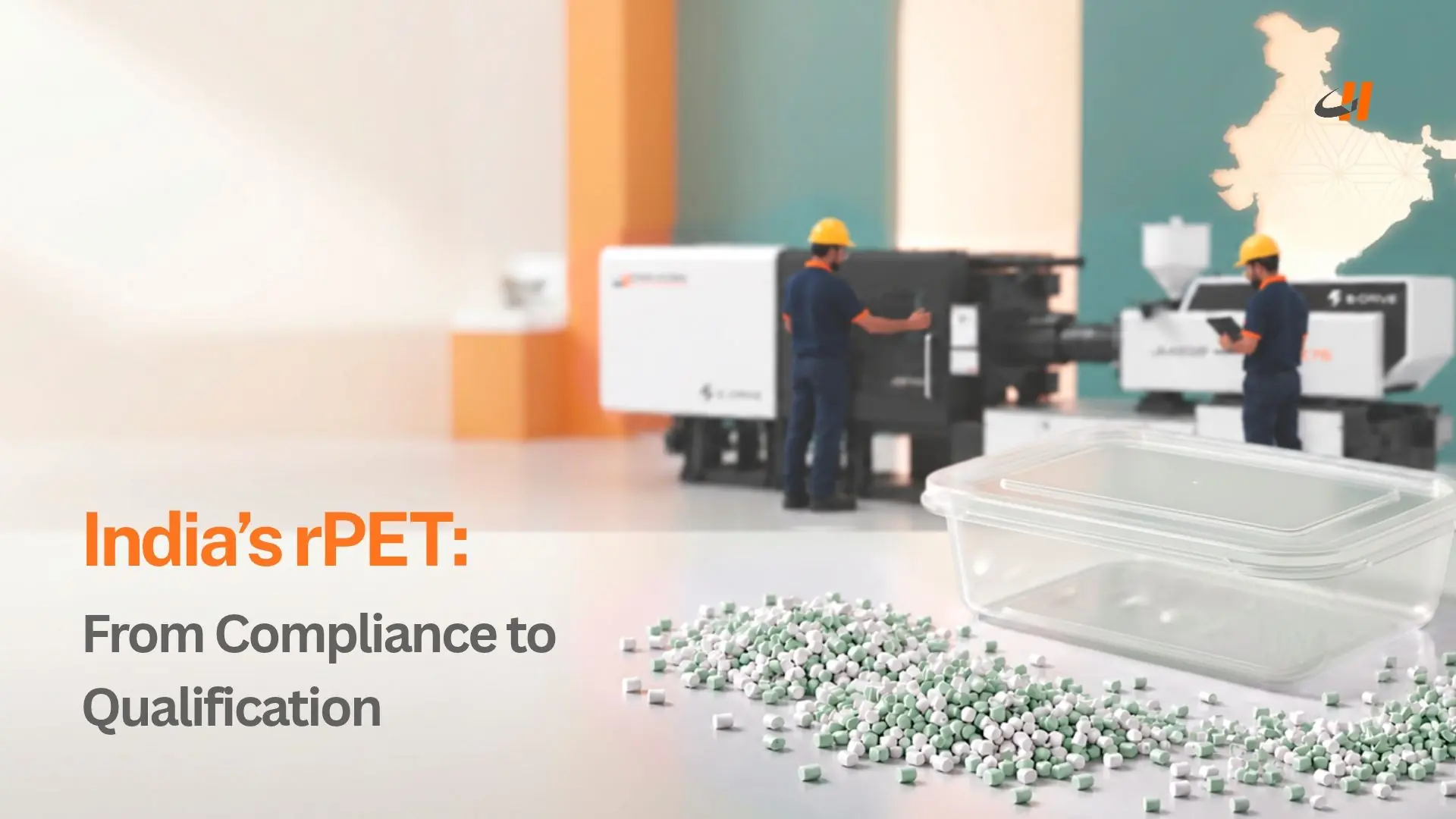
India’s packaging EPR regime makes plastic packaging waste a business responsibility for producers, importers, and brand owners. Food-contact rPET needs a separate qualification route; EPR does not, by itself, establish that a recycled resin is suitable for a food-contact packaging application. For converters, the next task is to qualify the rPET material, validate the molding process, and maintain evidence that the finished part meets the intended application.
This distinction matters because food-contact rPET is not ordinary post-consumer recycled (PCR) material. India’s food authority, FSSAI, separately lists applicants authorised to manufacture food-grade rPET resin for food-contact applications. EPR accountability and food-contact suitability therefore belong in the same production plan, but they are not the same approval.
Food-contact rPET needs a qualification route
This process prevents two common mistakes. The first is treating an EPR registration or recycled-content claim as food-contact clearance. The second is treating a successful short trial as proof of stable volume production. Both shortcuts can leave a converter with an approved-looking material but an unreliable packaging part.
An approved resin still needs a controlled production window
For precision parts or applications where cleaner production and repeatable process control are priorities, SPARK AE all-electric machines are another potential fit. The platform uses servo motors on every axis and is positioned for precision, clean production, and applications including thin-wall packaging.
For lunch-boxes and rigid food containers, MK7S is another option. In a Chen Hsong collaboration, GOBAPLASTIC, a Dominican producer of PET caps, containers, and bucket lids, reported improved cycle times and lower energy use after upgrading. Its standard e-Drive plasticising can run during mold opening and closing, helping cut cycle time and plasticising energy.
Where PET bottle preforms are the target product, our JM-PET/S2 provides PET-specific processing. Its 25:1 PET screw, anti-contamination design, stainless-steel product chute, and large water manifold are designed to support melt quality, clean handling, and cooling stability in food, beverage, cosmetic, and pharmaceutical preform production.
Note: None of these production platforms turns a non-qualified resin into a qualified material. Their role is to provide the production capability around a material and mold that have already been assessed for the application.
Bringing Greater Control to Recycled-Material Production with StabMolding
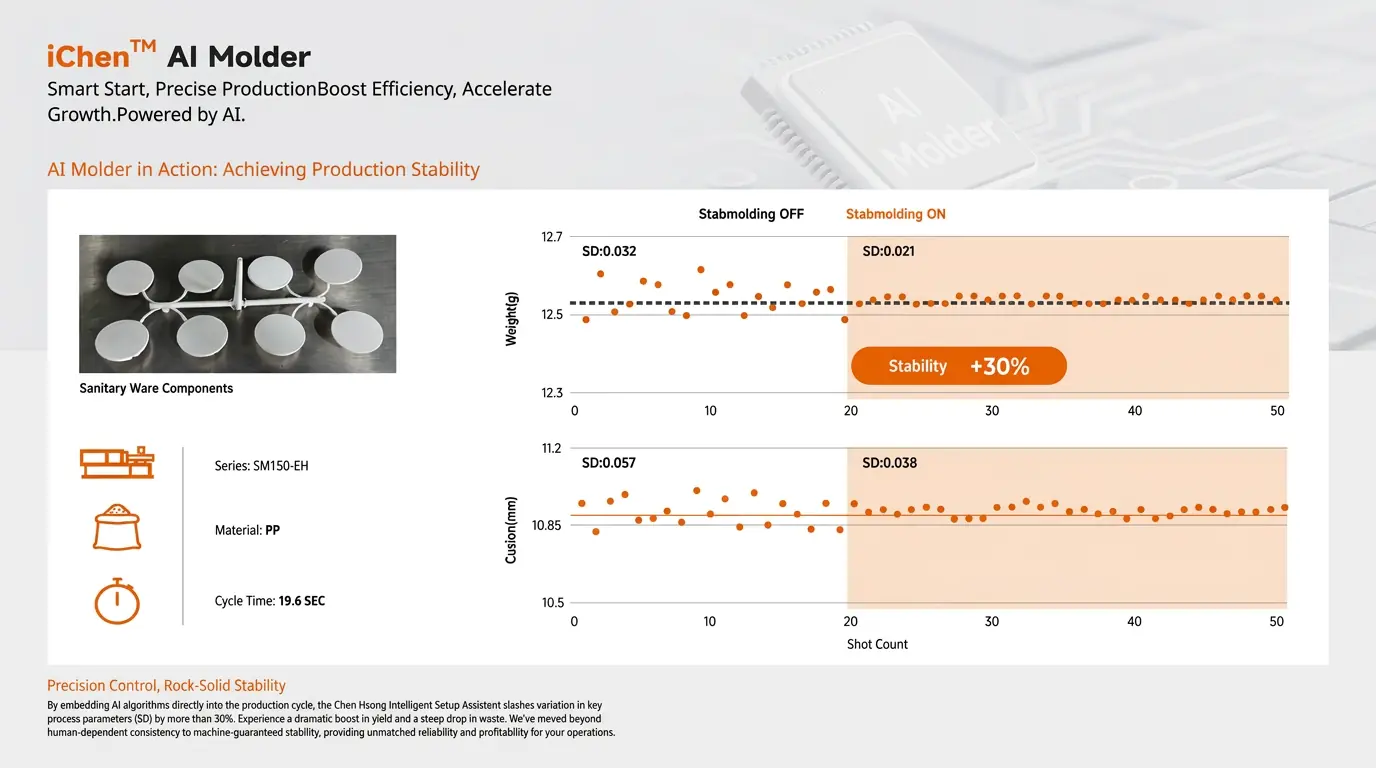
StabMolding is the mass-production stabilisation module within our iChen™ AI Molder system. It compares each shot’s real-time injection-pressure curve with a reference profile and, when it detects drift, automatically fine-tunes holding pressure and V-P switchover to help keep the process closer to target. Using data already generated by the machine, it supports shot-by-shot correction without external cavity-pressure sensors or mold modifications, subject to controller and installation compatibility.
This is especially valuable after an rPET grade has been qualified and production moves into volume runs. Recycled materials can introduce viscosity variation and changing process conditions; StabMolding helps manufacturers respond with more controlled, repeatable molding. It does not replace food-contact assessment, material qualification, or customer approval, but it can help turn an approved material and mold setup into a more stable production process.
As this test was conducted with recycled material rather than specifically identified rPET, the result should be read as a demonstrated process-control outcome, not a guaranteed rPET result.
FAQs
Can rPET be used for high-volume caps, closures, and thin-wall packaging?
How can molders improve stability when using recycled material?
First qualify the material and establish the approved process. Then control material preparation, monitor the agreed part-quality measures, manage change, and validate output. On compatible Chen Hsong systems, StabMolding can support shot-by-shot correction using injection-pressure data.

