
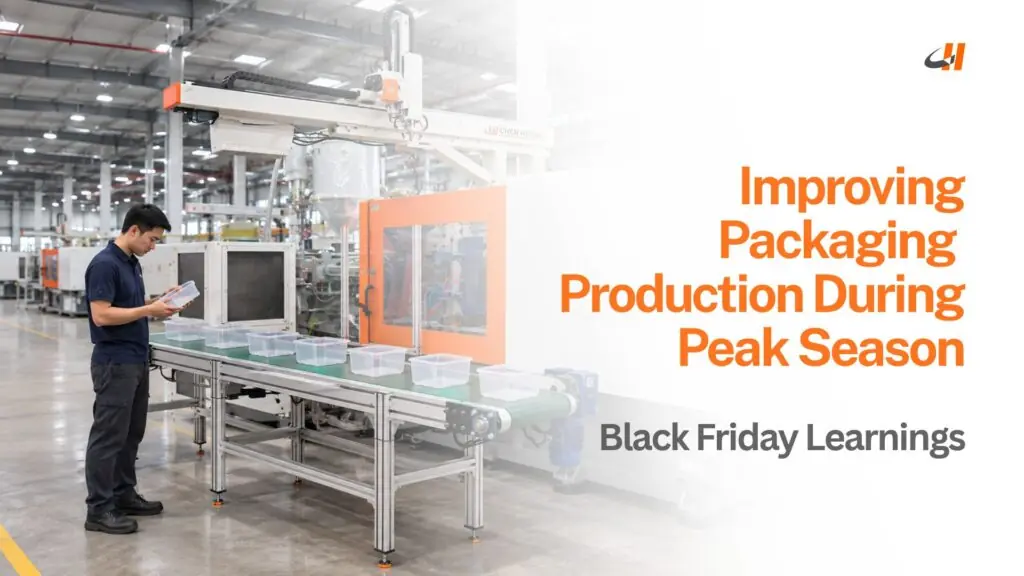
If you are considering how to improve packaging production during peak season, the experience around Black Friday and Cyber Monday can reveal where your existing setup needs attention. For manufacturers supplying international e-commerce, the useful lessons often come from production supporting the sales period: demanding packaging formats, repeated adjustments, small interruptions, and a changing product range.
With BFCM taking place on 27–30 November 2026, equipment upgrades should be planned for the next peak. Use this season’s experience to identify where better process support, clearer production information, or a different machine platform would make sense.
How to improve packaging production during peak season: four questions to ask
1. Which packaging formats need the most attention?
Some products run reliably with little intervention. Others repeatedly require slower cycles, extra inspection, or adjustments to maintain acceptable quality. A thin-wall food container, for example, places different demands on filling and cooling from a thicker storage-box lid.
If the same formats remain difficult across repeated orders, review whether the equipment is suited to that application. Our SPEED-PACK II is designed around high-speed thin-wall packaging, including food containers, caps, and closures. Our SUPER PACK provides another option for demanding high-volume packaging applications.
The lesson is to match the next investment to the products that consistently stretch the current setup. Trial the actual part and mold before deciding that a different machine will resolve the difficulty.
2. Why do longer runs require more adjustments?
A container may begin within its target weight range, then become less consistent later in the run. A lid may need repeated corrections to maintain its fit. These patterns are worth reviewing alongside material preparation, cooling, and mold condition.
Where process drift is part of the problem, our StabMolding feature within iChen™ AI Molder can support compatible machines. It compares injection-pressure behaviour with a reference and fine-tunes holding pressure and the point at which injection switches from filling to holding. This helps the process respond to variation during production, while normal product-quality checks remain essential.
If the application itself demands precision and cleaner operation, our SPARK AE all-electric machines are also worth evaluating for the next equipment upgrade. Their servo-driven axes provide independent control of machine movements; final suitability depends on the part, material, and mold.
3. Which small interruptions keep returning?
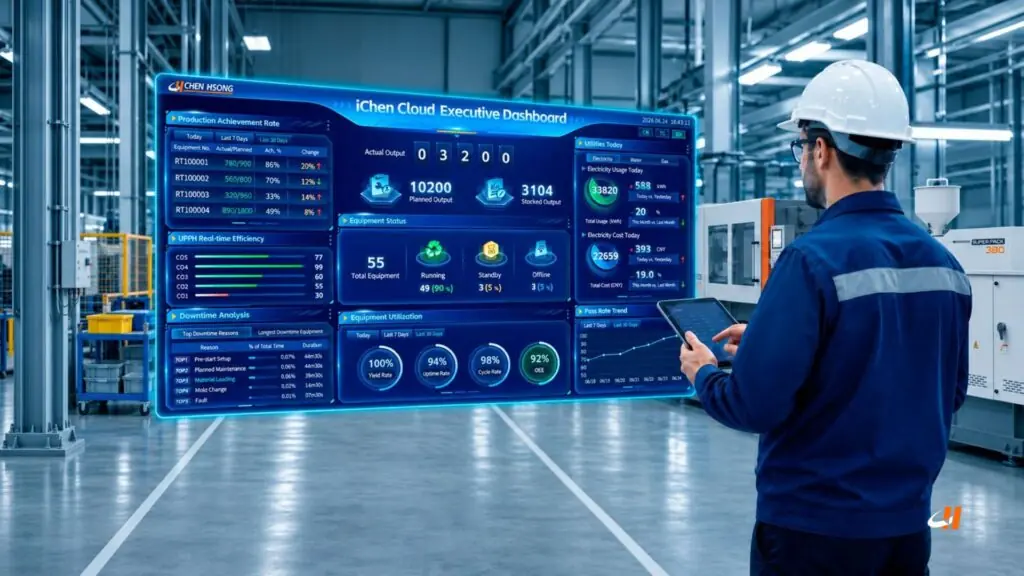
For example, repeated alarms on one press can be examined alongside its production and service history. That gives the team a clearer starting point for investigation. Better visibility helps identify where attention is needed; it does not automatically establish the cause of every stop.
4. Has your product range changed since you chose your machines?
A machine selected for one container size or household component may now be expected to handle a wider range. The equipment can remain reliable while becoming a less convenient fit for the work it is asked to do.
Review the products that dominate current orders, rather than selecting the next machine around an old product mix. For suitable rigid-container, household-product, and general-purpose applications, our MK7S is an option to assess.
Its standard e-Drive electric plasticising gives screw rotation an independent drive, allowing plasticising to overlap with mold movements under an appropriate configuration. This can be relevant when screw recovery contributes to cycle time. Machine selection should still account for mold dimensions, material requirements, and the rest of the production cell.
FAQs
Which of our machines should packaging manufacturers consider for high-volume production?
Can StabMolding be added to an existing machine?
Can iChen™ Cloud connect machines from different brands?
When is SPARK AE worth considering?
What makes MK7S relevant to a changing product range?
When should the next-peak improvement plan begin?
Plan a better next peak with our team
 Talk to our team about the challenges this BFCM reveals. We can help review your application and suggest an appropriate combination of process support, iChen™ Cloud connectivity, and machinery for your next production improvement.

