





















































Surging global temperatures place massive demands on factory output. Producing summer appliances requires immediate scalability to capture seasonal market share. Manufacturers relying on legacy equipment often face severe bottlenecks when attempting to ramp up production of air conditioner enclosures or cooling fan components. True factory agility demands mechanical solutions designed specifically for rapid shifts in consumer purchasing behaviour. Upgrading your injection molding systems offers the exact mechanical leverage needed to thrive during intense heatwave cycles.
Precision Polymer Flow for Vital Components
Global brands such as Beko supply highly complex washing machines and refrigerators to diverse international markets. The internal mechanisms of these white goods require flawlessly molded control panels alongside precision water dispenser housings. Processing engineering resins for these intricate parts demands absolute melt consistency.
The MK6.6 machine series resolves flow front challenges through specialised Japanese screw designs. Chrome-plated mixing screws provide flawless material preparation for temperature control dials or clear refrigerator crisper trays. Thickened core platens achieve significantly lower deformation than standard models on the market. Structural rigidity guarantees uniform clamping force across the entire mold face. Flawless surface finishes become the baseline standard for every intricate appliance component rolling off the assembly line.
Mastering High-Tonnage Scalability
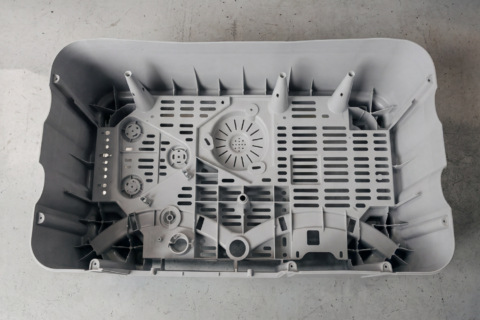
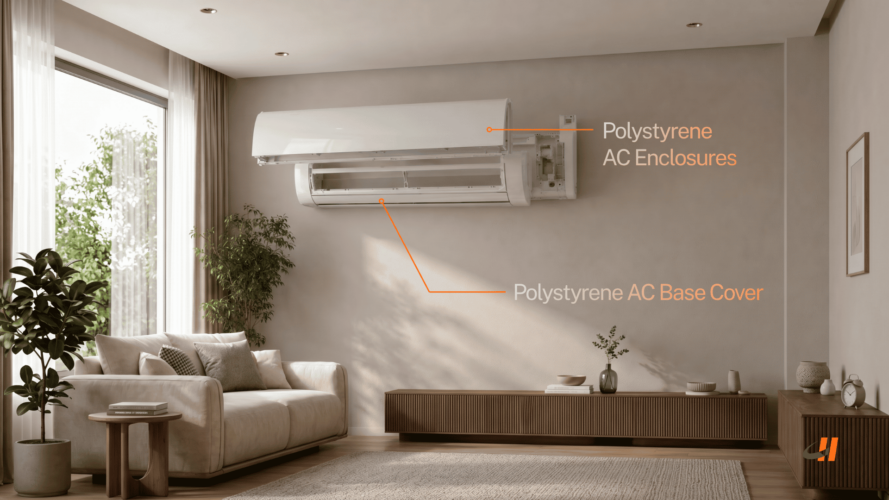
Scaling seasonal appliance production requires equipment engineered specifically for massive structural components. Home appliances brand, such as Midea, historically relied on one of our two-platen machines, 1,000-ton JM1000-C3-SVP/2, to produce 1,134g High Impact Polystyrene air conditioner enclosures in a swift 43.5-second cycle.. That proven foundation now evolves into the MK6 Large series. This upgraded platform provides superior platen stress distribution to handle massive shots flawlessly while keeping peak summer energy costs low.
Handling even heavier structural cooling components requires highly specialised tonnage control. The JM SM1250-TP-SVP/2, another two-platen injection molding machine, has also historically delivered the precise mechanical stability required to mold oversized air conditioner base covers. Accurate clamping force ensures these foundational parts support heavy internal compressors without dimensional warping.
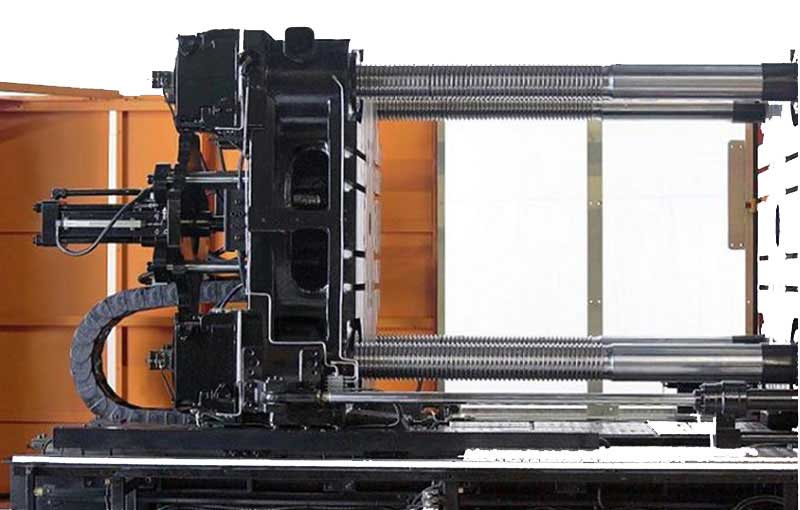
Transitioning to oversized interior white goods requires dedicated deep-draw capabilities. Chen Hsong’s latest two-platen SM-TP7 effortlessly meets the extreme physical demands of molding deep refrigerator tubs or structural washing machine drums. This architecture also offers the operational versatility to run bulky household items like large storage containers. Upgrading high-tonnage floor assets provides the raw mechanical scale necessary to dominate surging retail demand.
Multi-Product Agility on the Factory Floor
Unpredictable climate shifts force facility managers to pivot product lines rapidly. Transitioning from producing large structural housings to intricate internal components traditionally consumes hours of valuable factory time. Minimising this downtime is crucial for maximising seasonal profitability.
Modern machine architecture slashes mold changeover durations entirely. The MK6.6 utilises precision T-slots with mounting holes to drastically reduce the time needed to secure new tooling. Simultaneously, the SM-TP7 incorporates a non-contact tie-bar design to lower friction on the moving platen.
The Energy Efficiency Imperative
Running industrial facilities continuously during peak heatwaves strains utility budgets severely. Large-scale manufacturing must balance aggressive output targets with sustainable power consumption practices. Advanced servo-driven power packs drastically alter the financial reality of running high-tonnage equipment.
Optimised power management systems draw only the precise electrical load required for each specific cycle phase. Energy waste is virtually eliminated during cooling or idle periods. Facilities can run dozens of machines simultaneously without facing exorbitant peak utility penalties. Profit margins remain highly protected even under the most demanding summer production schedules.
Frequently Asked Questions
1. What is the most effective way to reduce cycle times for large appliance enclosures?
Integrating machinery with diagonal high-speed cylinders ensures smoother mold opening motions. This engineering choice significantly accelerates the overall cycle time for massive structural parts.
2. How do upgraded platens prevent defects in clear refrigerator components?
Thickened platens resist the immense pressures of the injection phase. Eliminating centre deflection ensures the mold remains perfectly sealed against flash defects.
3. Why are specialised screws necessary for appliance control panels?
Different engineering resins require specific shear rates to melt properly. Bimetallic or chrome-plated mixing screws prevent material degradation while ensuring a perfectly uniform melt state for pristine cosmetic finishes.
Surging global temperatures place massive demands on factory output. Producing summer appliances requires immediate scalability to capture seasonal market share. Manufacturers relying on legacy equipment often face severe bottlenecks when attempting to ramp up production of air conditioner enclosures or cooling fan components. True factory agility demands mechanical solutions designed specifically for rapid shifts in consumer purchasing behaviour. Upgrading your injection molding systems offers the exact mechanical leverage needed to thrive during intense heatwave cycles.
4. What is the best injection molding machine for large air conditioner enclosures?
Processing massive structural components requires robust two-platen architecture. Equipment like the SM-TP7 handles extreme shot weights effortlessly through dual injection carriage cylinders. This specific design maintains perfect nozzle alignment to prevent resin leakage during high-pressure injection phases. Heavy-duty platen sliding feet support the massive tooling required for these exterior appliance parts while completely preventing mechanical sagging.
5. How do you fix flash and short shots on air conditioner control panels?
Molding precise cosmetic components requires absolute mechanical stability to avoid surface defects. Factory temperature fluctuations during heatwaves often lead to viscosity shifts in the resin. Smart sensors that monitor mold conditions instantly allow systems to auto-adjust speed or pressure mid-cycle. The MK6.6 utilizes this self-correcting precision alongside thickened core platens to achieve incredibly low deformation. This setup guarantees pristine surface finishes on cooling appliance interfaces without requiring manual operator intervention.
6. What is the best injection molding machine for large air conditioner enclosures?
Processing massive structural components requires robust two-platen architecture. Equipment like the SM-TP7 handles extreme shot weights effortlessly through dual injection carriage cylinders. This specific design maintains perfect nozzle alignment to prevent resin leakage during high-pressure injection phases. Heavy-duty platen sliding feet support the massive tooling required for exterior air conditioning units while completely preventing mechanical sagging.
7. How do manufacturers eliminate burn marks on clear refrigerator crisper trays?
Flawless transparent bins demand exact thermal management inside the barrel. Upgrading to specialised Japanese screw designs prevents the material degradation that causes yellowing or cosmetic defects. Chrome-plated mixing screws process sensitive clear resins efficiently to ensure pristine optical clarity for consumer-facing refrigeration parts.
8. What equipment features guarantee perfectly balanced cooling fan blades?
Aerodynamic parts mandate absolute dimensional stability to prevent operational vibrations. Achieving these tight tolerances requires low-friction injection linear guides. These precision guides allow for faster injection speeds while delivering the high-precision repeatability needed to mold perfectly balanced fan blades consistently.
9. How can factories speed up production for intricate appliance control panels?
Small cosmetic components rely heavily on rapid cycle times and highly efficient tooling changeovers. Utilising machines equipped with T-slots and integrated mounting holes significantly reduces the time spent swapping out molds. Thickened core platens protect these delicate tools from deformation to guarantee pristine surface finishes on every control dial.
Looking for more specific answers about your production? Contact us via our local offices.